A homeschool Quran weekly plan should make your family’s routine clearer, not turn every day into a crowded timetable. Start with the child’s current skills, decide which subjects need live teacher guidance and leave room to review what has already been taught.
The example below covers the Quran and Islamic Studies part of a homeschool week. It is supplementary subject planning, not a complete academic curriculum or advice about local homeschool requirements.
Start with separate learning goals
Write down what your child needs in each area. A child may read Quran fluently but need memorization revision. Another may remember short surahs by listening while still learning to read Arabic words. Islamic Studies understanding is a separate starting point again.
Choose a small number of priorities for the first period of study. “Read joined words more accurately” is clearer than “improve Quran.” “Explain the main steps of wudu” is clearer than “finish Fiqh.”
Decide what the teacher and parent each handle
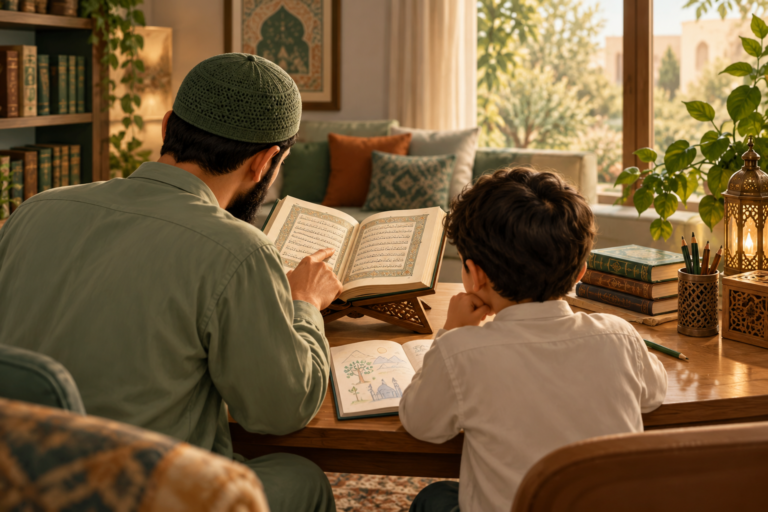
A teacher listens to recitation, corrects pronunciation, explains new material and checks understanding. A parent can organise the setting, encourage short practice and report when the work is too easy, difficult or time-consuming.
You do not have to become an Arabic specialist to help your child keep a routine. Agree exactly what should be practised, rather than adding a new exercise or rule without knowing how it fits the lesson.
A sample week with two live lessons
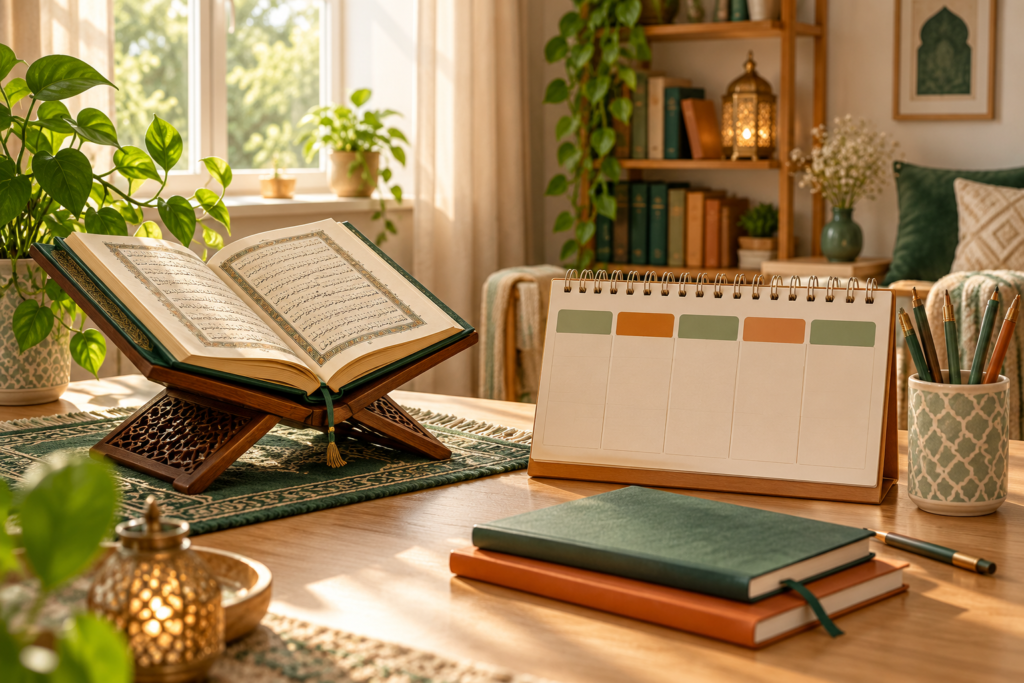
| Day | Suggested focus | Purpose |
|---|---|---|
| Monday | Live Quran reading or revision lesson | Identify the week’s recitation target |
| Tuesday | Short assigned practice | Repeat corrected material carefully |
| Wednesday | Review and note one question | Notice what still needs help |
| Thursday | Live Islamic Studies lesson | Learn, discuss and check a suitable topic |
| Friday | Brief recall and a practical task | Connect the lesson to daily life |
This is an illustration, not a fixed Muruj timetable. Families can change the days and lesson length. If Quran, Arabic and Islamic Studies all require substantial new teaching, two short lessons may not provide enough time for every goal; discuss additional sessions or alternating subject blocks.
Give revision a visible place
Do not reserve the whole week for new content. For Hifz, agree how new memorization, recent revision and older revision will be balanced. For reading, repeat the skill that caused difficulty before moving to longer passages.
Keep the assignment precise: which lines, words or surah, how to practise and what the teacher will check next. A child should not have to guess what “revise Quran” means.
Use one practical Islamic Studies task
Choose an action related to the lesson. After studying good speech, the child might notice one situation in which kind words were difficult. After a wudu lesson, they might explain the sequence to a parent and bring uncertainties back to the teacher.
The task should fit the child’s age and family circumstances. It need not involve public posting, spending money or sharing private information. Ask the child what they learned rather than simply checking whether a box was ticked.
Review the plan before increasing it
At the end of the week, ask: what can the child now do, what still needs support, and was the workload manageable? A short note under these three headings can be more useful than recording only the number of pages covered.
If the same work repeatedly causes frustration, discuss whether the task, lesson length or starting level needs adjustment. Do not respond automatically by adding more minutes.
Plan siblings individually
Children can share a family routine while having different assignments. One may work on letter blending and another on Tajweed or Tafsir. Confirm whether any proposed shared lesson is suitable and how each child will receive attention.
If you are planning for an older learner, our guide to Quran classes for teenagers alongside school commitments covers personal goals, feedback and adjustments during busy weeks.
Build the Islamic part of your homeschool with guidance
Explore Muruj’s Quran and Islamic Studies support for homeschool families for a personal learning plan. The service complements your academic curriculum rather than replacing a full-time school.
Book a free trial and share each child’s age, Quran level, priorities and time zone so the team can discuss a realistic timetable.
Ready to build a clear learning plan?
Start with a free level assessment and get a learning path matched to your level and goals.