Arabic for non-Arabic-speaking kids should begin with a clear learning goal and a check of what the child already understands. A learner who recognises letters may still need help following a spoken instruction, while a child who understands familiar speech may be new to reading.
Rather than choosing a course only by age, describe how your child currently uses Arabic and what you hope they will do with it. This makes the starting conversation with a teacher more useful.
Choose the main goal before choosing materials
Is your priority Quran-related vocabulary, general Arabic reading, classroom language or everyday conversation? These goals can overlap, but the examples and practice tasks may differ. Ask which goal the proposed course addresses first.
Muruj’s Arabic classes for kids begin with a level discussion. Tell the team whether your child has studied before and which language they use most comfortably for explanations.
Check four skills separately
| Skill | A useful question |
|---|---|
| Listening | Can the child follow a familiar, simple spoken prompt? |
| Speaking | Can they answer with a word or phrase without copying every sound immediately? |
| Reading | Can they recognise the letters and signs in the material being used? |
| Writing | Can they form or copy the assigned letters at an appropriate level? |
These questions help you describe your child; they are not a formal placement test. Ask a teacher to assess the combination of skills and choose suitable tasks.
Use one manageable theme at a time
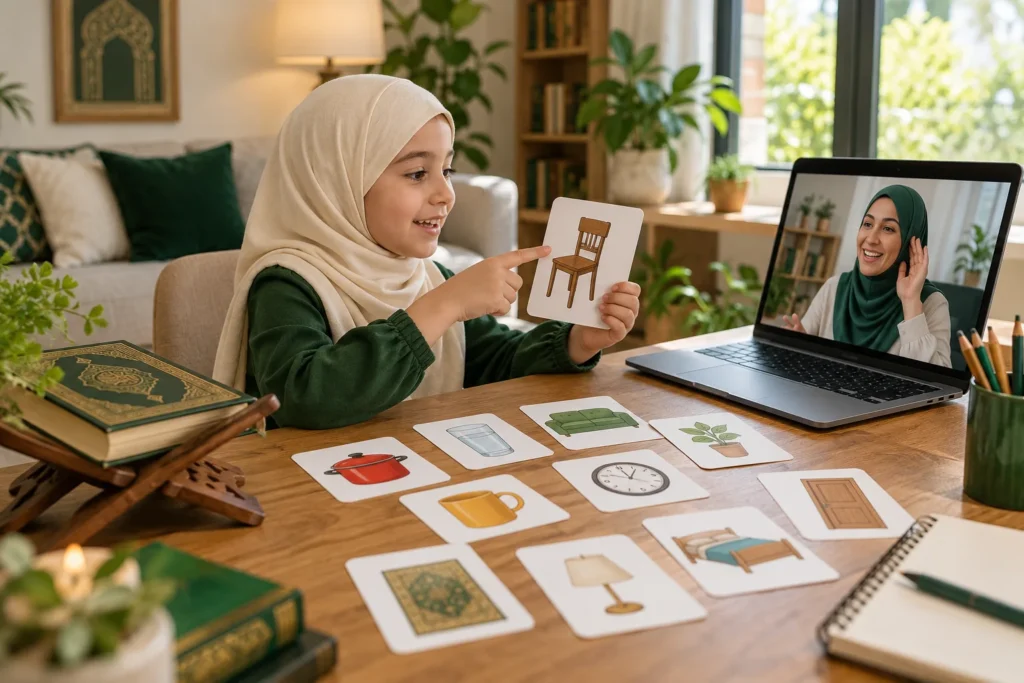
A theme such as classroom objects can connect listening, naming, reading and writing. Ask the teacher which words and sentence pattern to revisit. A small, consistent set makes it easier to notice whether the child understands rather than only repeats.
For home practice, you might point to an object and use the agreed word, or invite the child to answer a question already practised in class. Do not introduce a large new word list simply because a worksheet is available.
Understand which Arabic variety is being taught
Ask whether the course uses Modern Standard Arabic, Quran-focused language work or a spoken dialect, and how that choice relates to your goal. A family’s home expressions may differ from the wording used in a textbook.
For help framing the question, read Quranic Arabic versus Modern Standard Arabic. Avoid treating a difference in variety as an error before asking the teacher.
Make room for meaning as well as repetition
After your child repeats a word, check whether they can connect it with the relevant picture, object or action in the agreed activity. For a phrase, ask the teacher for a simple way to use it in context.
If reading is the difficulty, use a suitable progression rather than pushing conversation worksheets that the child cannot decode. Our guide to Arabic reading from letters to words explains the questions to consider.
Frequently asked questions
Do parents need to speak Arabic at home?
You can support a clear routine and use teacher-approved tasks without being fluent. Explain your limits so the home work does not depend on corrections you cannot check.
Should we start speaking and writing together?
Ask the teacher how to balance the skills for your learner. Prior knowledge, comfort with the script and the main goal all matter.
How soon will my child speak Arabic fluently?
There is no responsible single deadline for every child. Ask for specific early goals, such as understanding an agreed prompt or using a practised phrase with less help.
Choose a starting point that fits your child
Book a free trial with Muruj to discuss your child’s current Arabic skills and your family’s goal. Confirm the language variety, materials and realistic home task before choosing a continuing plan.
Ready to build a clear learning plan?
Start with a free level assessment and get a learning path matched to your level and goals.