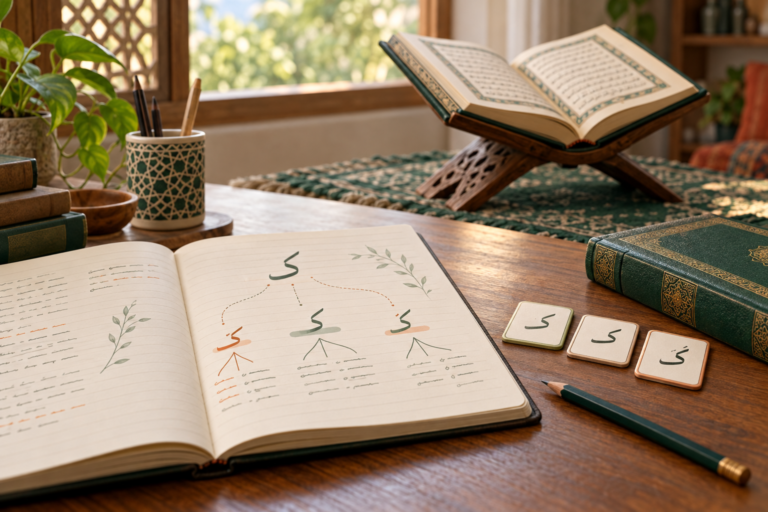
Your child can name Arabic letters on flashcards, but a short word in a Qaida suddenly feels unfamiliar. If your child knows Arabic letters but cannot read words yet, this is a useful clue: recognizing a letter by itself and reading it inside a word involve several different skills.
The next step is to find where the reading process becomes difficult, then practise that part gently with a teacher. This guide will help parents notice the difference between letter shapes, vowel marks and blending—without treating a child’s hesitation as a lack of effort.
Why knowing the alphabet is only the beginning
A learner may know the names of ب, ت and ث, yet still need to recognize their shapes in a connected word, notice the dots, identify a vowel mark and put the sounds together from right to left. Knowing a letter’s name is helpful; reading requires the learner to connect its written form with its sound in context.
For a general overview of the sequence, see Arabic reading for beginners: from letters to words. Here we focus on what to do when a child gets stuck between those stages.
Find the step your child finds difficult
Ask the teacher to listen to a few familiar and unfamiliar examples. The following observations suggest questions to explore, not a diagnosis:
| What you notice | What may need practice | What to ask the teacher |
|---|---|---|
| Recognizes a letter alone but misses it inside a word | Different connected forms and dot positions | Can we compare one letter in different positions? |
| Identifies the letter but overlooks its mark | Short vowel marks | Which vowel marks should we review first? |
| Reads each part separately but stops before combining | Blending sounds in reading order | Could you model a short combination for us? |
| Reads a familiar page from memory but cannot try a new example | Applying the same skill in a new context | Can we try a new example using the same pattern? |
| Recognizes the shape but the sound is uncertain | Hearing and producing the sound | Could you listen and show how to practise it? |
More than one skill may need attention. There is no need to restart the entire book automatically; ask which short review would support the next step. Our online Quran reading classes begin with an assessment and include guided practice with a teacher.
1. Look for familiar letters in connected forms
Arabic is read from right to left. Many letters change their appearance depending on where they are in a word, while their dots remain important clues. For example, the letter ب can appear on its own as ب or at the beginning of a connected word as بـ.
Try pointing to one example chosen by the teacher and asking, “Can you find the ب?” Then compare it with the same letter in a different position. Use only a small number of examples at a time. The aim is to notice the shape and dots, not to race through the alphabet.
Some letters do not connect to the following letter, so a gap can appear within a word. Ask the teacher to show this in the child’s own reading book; a gap does not always mean the word has ended.
2. Check the vowel mark as well as the letter
The short vowel marks change the sound read with a letter. For example, بَ, بِ and بُ use the same letter with different marks: fathah, kasrah and dammah. Ask your child to point to the mark before reading, then listen to the teacher’s model and try again.
A parent does not need to guess the pronunciation from English spelling. If you do not read Arabic, ask the teacher for a short approved audio example or a demonstration during the lesson. English approximations cannot capture every Arabic sound.
3. Move from separate sounds to a short combination
Once the teacher has checked the letters and marks, ask them to model a short combination from the child’s Qaida or Noor Al-Bayan lesson. The learner can follow in reading order, listen, try the parts and then attempt them together. Keep the example at the level the teacher has already introduced.
For example, بَتَ is a simple practice pattern with a fathah on each letter; it is a reading exercise, not a Quranic quotation. The teacher can demonstrate the sounds and decide whether this example is appropriate. If it is still difficult, return to a smaller step and try again later.
A five-minute practice routine for home
This is a flexible example, not a fixed prescription. Ask the teacher to select the material first.
- One minute: Look at one or two familiar letter forms and their dots.
- One minute: Point to the short vowel mark and listen to the teacher’s model.
- Two minutes: Try one or two short combinations together, giving the child time to answer.
- One minute: Let the child try a similar example and finish with specific encouragement, such as “You noticed the dot yourself.”
Stop earlier if the child is tired. If a sound is uncertain, make a note for the teacher rather than repeating an unverified pronunciation. A few calm attempts can tell you more than completing a page under pressure.
How can a parent help without reading Arabic?
You can support the routine even if you cannot check every sound. Keep the teacher’s chosen page available, play the approved model, ask your child to point as they read and notice where they hesitate. Your role is to make practice manageable and pass observations to the teacher; the teacher can check recitation and correct pronunciation.
A helpful message might say: “My child recognizes the letters separately but pauses when they appear together. Could you show us one pattern to practise and explain what to listen for?” Use the academy’s official communication channel and share only the information needed.
Signs of progress beyond finishing pages
Look for small changes over several lessons: your child identifies a familiar letter in a new position, notices a vowel mark without a reminder, attempts a short unfamiliar example or explains which part feels difficult. A learner may still read slowly while building accuracy. Ask the teacher which examples are suitable for an independent attempt and how to tell when the child is ready for a new pattern.
Progress is individual; a particular page count or fixed number of weeks does not guarantee readiness. Our guide to tracking your child’s Quran learning progress offers more ways to observe development without relying only on pages completed.
What if the child is frustrated or keeps guessing?
Pause and reduce the task. A child who guesses may be trying to manage too many unfamiliar shapes or marks at once, but a teacher needs to observe the reading before deciding what is happening. Ask whether the example can be broken down or whether a previously learned pattern needs review. Avoid comparing siblings or correcting every attempt at once.
If the difficulty continues despite patient teaching, discuss what you have noticed with the teacher and, where appropriate, the child’s school or a qualified specialist. This guide cannot assess or diagnose a learning difficulty.
When should a child begin reading from the Quran?
Ask the teacher to assess the child’s ability to identify connected letters and marks, attempt short unfamiliar combinations and accept guided correction. Children may encounter short Quranic examples while learning their primer, and the transition can be gradual. The appropriate starting point depends on the child and the teaching plan; finishing a particular page is not the only measure.
Get help choosing the next step
Muruj Al-Quran Academy offers live one-to-one Quran and Arabic lessons. Tell us whether your child can identify separate letters, recognize vowel marks or read short connected examples, and ask for a suitable starting point. You can ask about a free trial lesson or explore our online Arabic classes. Confirm lesson availability and current terms with the academy.
Ready to build a clear learning plan?
Start with a free level assessment and get a learning path matched to your level and goals.