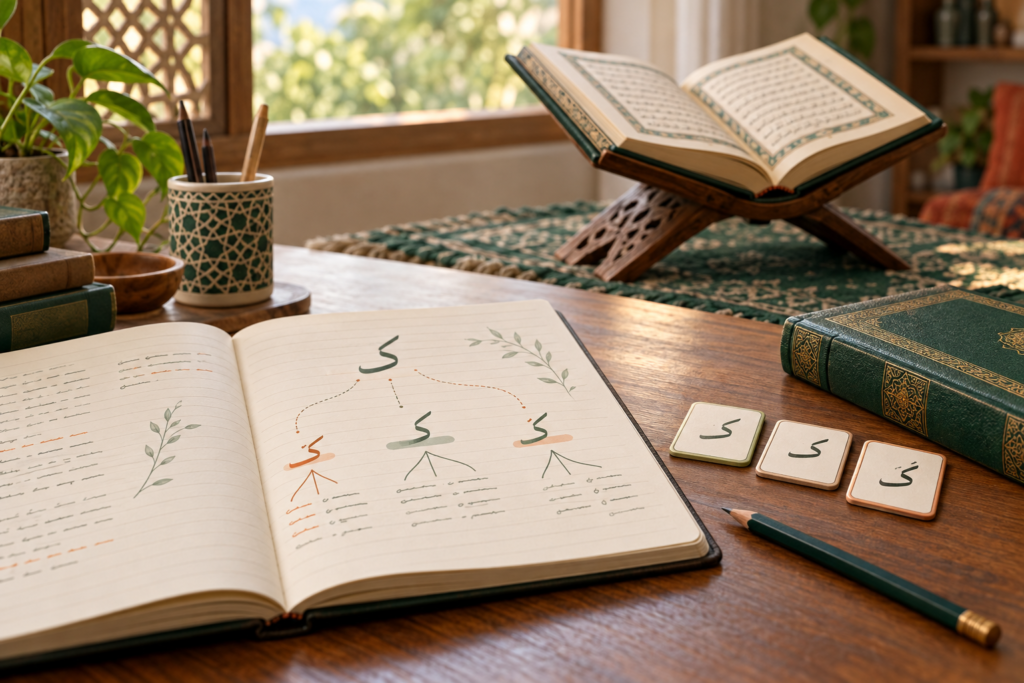
Arabic roots in the Quran can help a learner recognise relationships between words. A root is a group of core consonants associated with a family of related words, while a word’s pattern and grammatical form help shape its use. Learning these relationships is useful, but a root alone does not tell you the complete meaning of every word in a verse.
This guide introduces a practical vocabulary method. It is different from a complete Arabic grammar course or a Tafsir explanation of a passage.
Think in families, not isolated labels
Many Arabic words belong to families that share root consonants. For example, the root ك ت ب appears in words associated with writing, such as كَتَبَ, “he wrote,” and كِتَاب, “book.” These simple examples show a connection, but they do not establish one English meaning that can be inserted into every occurrence.
A learner can notice the shared consonants, then study the actual word as it appears in a sentence. Keep both parts of the process: recognition of the family and understanding of the specific form.
What does a word pattern contribute?
Arabic uses patterns that organise consonants and vowels into forms. Different forms may indicate a person, action, object or another grammatical function. You will meet these gradually as you study morphology and grammar.
Do not try to memorise every pattern before building a small usable vocabulary. Start with the forms your teacher selects and connect each form with a clear example. Seeing the same form in another passage provides an opportunity to check your understanding.
Why the root is not the whole meaning
Context, grammar and established usage matter. Related words do not always have interchangeable meanings, and a dictionary may list several senses for the same word. Selecting the meaning that sounds most attractive in English is not a reliable method of understanding a verse.
When studying Quranic vocabulary, confirm the meaning of the word in its passage. If an interpretation goes beyond basic vocabulary, consult recognised Tafsir with guidance. Root recognition supports language learning; it does not replace scholarly explanation.
Build a vocabulary record with four fields
| Field | What to record |
|---|---|
| Word in the passage | The actual form you are studying |
| Root, if identified | The core consonants confirmed by your teacher or agreed reference |
| Meaning in context | A short explanation appropriate to that occurrence |
| Related example | One verified word from the same family |
Use a reliable dictionary or teaching resource recommended for your level. Not every written letter belongs to the root, and some forms are difficult to analyse without further study. Mark uncertain entries as questions rather than treating your first guess as fact.
A short practice routine
- Select a few words from a passage assigned by your teacher.
- Read the words accurately and check their meanings in context.
- Identify a root or pattern only where you have reliable guidance.
- Compare one related form and notice what changes.
- Return to the passage and explain the actual word being used.
Review older entries before adding a long new list. Recognition during real reading is a more useful check than remembering a root without knowing the words that contain it.
Common beginner mistakes
Avoid assuming that similar-looking words always share a root, that every Arabic word has exactly three root letters, or that one root has one fixed English translation. These shortcuts can make a vocabulary notebook look organised while introducing misunderstandings.
It is also easy to become absorbed in identifying roots and stop following the meaning of the passage. Keep language analysis proportionate to your current goal and level.
Study roots as part of Quranic Arabic
Muruj’s Quranic Arabic classes bring vocabulary, word patterns and grammar together through guided examples. For explanation of verses, explore Tafsir in English.
Book a free trial and tell us whether your priority is reading the Arabic script, recognising vocabulary or studying grammar in more depth.
Ready to build a clear learning plan?
Start with a free level assessment and get a learning path matched to your level and goals.